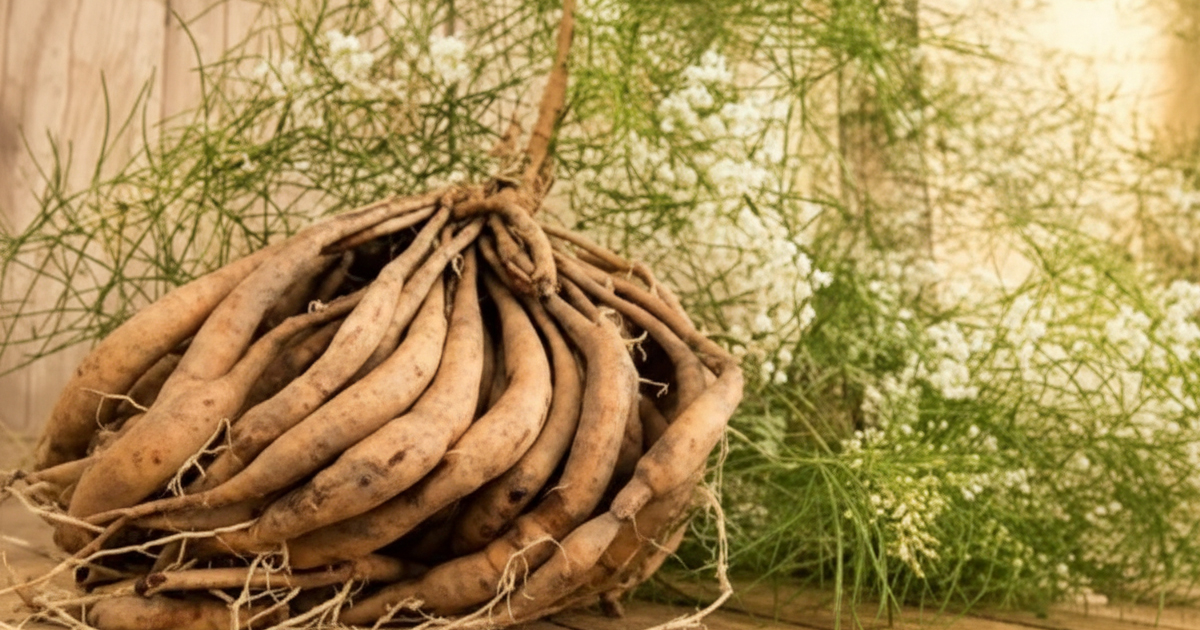
Here are some other names of Shatavari Rasa (Asparagus racemosus),
1. Hindi – Shatavari (शतावरी)
2. Sanskrit – Shatavari, Narayani, Bahusuta
3. Tamil – Thaneervittan Kilangu (தனீர்விட்டான்கிழங்கு)
4. Malayalam – Sathavari (ശതാവരി), Nannari
5. Kannada – Majjige Gadde (ಮಜ್ಜಿಗೆಗಡ್ಡೆ)
6. Telugu – Pilligaddu (పిల్లిగడ్డు)
7. Marathi – Shatavari (शतावरी)
8. Gujarati – Shatavari (શતાવરી)
9. Bengali – Shatamuli (শতমূলী)
10. Oriya (Odia) – Shatabari (ଶତବରୀ)
11. Punjabi – Shatavar (ਸ਼ਤਾਵਰ)
What is Shatavari Rasa?
The uses of the herb have been considered for centuries in the Indian treatment system of Ayurveda, where fertility enhancement was one of its many alleged activities.
The herb is classified as an adaptogen, which is thought to balance and support the body in coping with stress.
Health and Skincare Benefits
Antioxidant capacity:
Antioxidants protect the organism from free radical-induced destruction, which injures cells and initiates disease development, ranging from cancer to several others. Antioxidants are also capable of combating oxidative stress, which is one of the many causative factors for disease.
Anxiety lowering:
Traditionally, Shatavari supplements have also been employed to combat anxiety and depression. No research has investigated this effect in humans, but the studies support that this plant may have these effects in rats.
Lowering sugar:
Shatavari can be helpful in maintaining blood sugar levels. Some researchers opine that the herb may be of some benefit to individuals diagnosed with type-II diabetes.
As a cough remedy:
In cough amelioration, Shatavari root extract showed effective results in mice comparable to codeine phosphate, a prescribed cough medicine. In India, the juice of Shatavari roots is a common cough remedy.
For the treatment of diarrhea: Shatavari fights against diarrhea.
Improving gastric ulcers:
Shatavari treated experimentally induced ulcers in the food pipe and stomachs of rats. The authors concluded that the herb was nearly as effective as the drug ranitidine, commonly used to treat ulcers in human beings. However, they stated that shatavari did not show as good an effect in treating ulcers induced by stress.
May act as an anti-aging agent:
Shatavari could be one of nature's best-kept anti-aging secrets. The saponins in shatavari root helped in reducing free-radical skin damage that leads to wrinkles. The shatavari also helped in preventing collagen breakdown. Collagen keeps your skin elastic.
May treat depression:
Shatavari has been used in Ayurveda for treating depression. The antioxidants contained in shatavari possess strong antidepressant properties. They also exerted influence on the neurotransmitters of the brain. Neurotransmitters relay information throughout our brain. Some are associated with depression.
Digestive Support Shatavari:
The herb that calms the digestive tract and reduces the effects of acidity, ulcers, and irritable bowel syndrome (IBS). Its cooling property assists in pacifying Pitta-type digestive ailments.
Immunity and vitality:
It boosts immunity through increased phagocytic activity by white blood cells and works as an overall tonifier to impart vigor and vitality.
Respiratory Health:
Shatavari is quite effective in the case of any bronchitis problems, cough, colds because of its anti-inflammatory and soothing effects.
Skin and Hair Benefits:
The herb nourishes skin, alleviates inflammation, and increases hair growth. Its antioxidant property works wonders against free radical damage.
Breastfeeding help:
Asparagus intake is very beneficial for breast-feeding mothers. It is actually a "galactogogue," which means that it increases milk production. Asparagus roots contain compounds that help increase the quantity and quality of milk during lactation.
Provides hydration and moisture:
By virtue of its hydrating and moisture-imbibing properties, Shatavari maintains the moisture balance of your hair. It prevents dryness and frizziness along with this, and keeps good health of hair. Hydration and Moisturisation: Adequate skin hydration is vital for a good complexion. Shatavari's natural properties help in retaining moisture so that the skin remains supple and well-hydrated. It is especially important for dry or sensitive skin since Shatavari can thus provide nourishment to prevent flaking and dryness.
Haircare Benefits
Deeply conditions hairs:
Deep conditioning of Shatavari improves hair texture, making it softer and more manageable. This conditioning adds shine to hair, reduces some typical issues like split ends and breakage, and promotes healthy scalp massage. Shatavari improves scalp massage health; therefore, it also results in healthy, strong, and vibrant hair. Regular use may result in some magical changes in your hair.
Calms scalp irritation:
Shatavari consists of anti-inflammatory properties that can help and calm scalp irritation. Whether it is dryness, itchiness, or inflammation, Shatavari's soothing properties matter in a healthier scalp environment, which is important for hair growth and overall scalp health.
Encourages hair growth:
Shatavari can promote hair growth by improving good blood circulation to the scalp and nourishment and hence health of good hair follicles. Improved blood flow brings the needed nutrients and oxygen to hair follicles, resulting in stronger and healthier hair.
Rich in Phytoestrogens:
Shatavari is well known because it is full of phytoestrogens, the plant compounds similar to estrogen in the body. These phytoestrogens are beneficial for hormonal balancing, thus leading to increased hair growth and decreased hair thinning. Hormonal balance is very important for healthy hair, and Shatavari is a very wise choice for balancing it naturally.
Tagged In:
Powered by Develixirs